A Breath of Innovation: How Nanomedicine Could Defeat TB
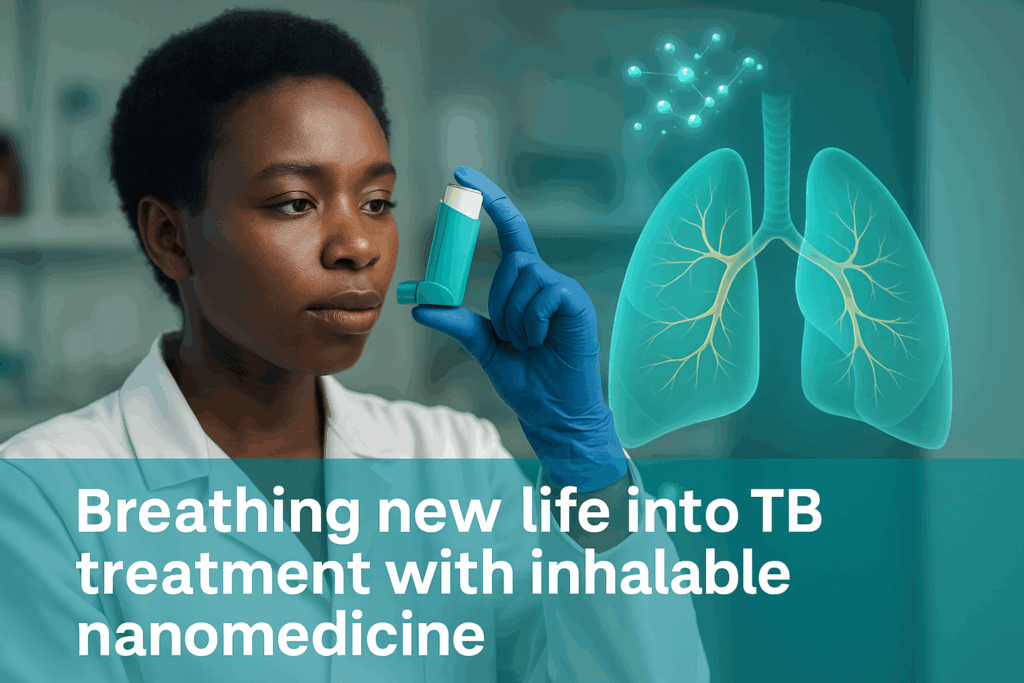
At the Wits Advanced Drug Delivery Platform (WADDP) in Johannesburg, postdoctoral researcher Dr. Lindokuhle Ngema is developing a groundbreaking inhalable nanosystem designed to deliver tuberculosis (TB) medications directly into the lungs, where the bacterium Mycobacterium tuberculosis hides and multiplies. This innovation, supported by the World Academy of Sciences (TWAS) fellowship and the Nuclear Medicine Research Institute (NuMeRI), could represent a significant turning point in the global fight against TB.
“TB is clever,” says Dr. Ngema. “It hides in lung pockets where oral drugs can’t reach. Our system is designed to be smarter and to deliver treatment exactly where it’s needed.”
Targeted Treatment for an Ancient Killer
Despite medical advances, TB remains one of the world’s deadliest infectious diseases, causing nearly 10 million new infections and 1.8 million deaths each year. In South Africa alone, over 56,000 lives were lost in 2023. The standard six-month treatment relies on four drugs—rifampicin, isoniazid, ethambutol, and pyrazinamide—that can lead to severe side effects and poor treatment adherence. Incomplete treatment has contributed to a surge in multidrug-resistant (MDR) and extensively drug-resistant (XDR) TB.
The WADDP’s inhalable nanocarrier could address these challenges by:
- Delivering all four standard TB drugs in one nanosystem.
- Releasing them directly at the site of infection.
- Bypassing the liver and bloodstream to reduce toxicity.
- Maintaining precise, sustained drug levels in the lungs.
“Precision nanomedicine allows us to treat smarter and faster—exactly what the WHO’s End TB Strategy envisions,” says Professor Yahya Choonara, Director of WADDP.
Inside the Nanosystem
The biocompatible nanocarrier is designed to encapsulate multiple TB drugs within a single inhalable formulation. Once inhaled, the nanoparticles travel deep into the lungs, releasing medication over time at targeted infection sites. Working alongside NuMeRI, researchers utilize nuclear imaging to track the nanoparticles in real time, confirming that the drugs reach “hidden” lung pockets that are missed by conventional treatments.
“The beauty of nanoscale science,” explains Ngema, “is that we can control where and when the drugs are released.”
From Lab to Life
Dr. Ngema’s research is driven by both innovation and compassion. “TB has taken too many lives for too long,” he says. “If we can make treatment easier, faster, and smarter, we’re not just improving outcomes—we’re restoring hope.”
By reducing treatment duration and the pill burden, the inhalable nanosystem could help patients complete their therapy, limit drug resistance, and accelerate global efforts to end TB by 2030.
Read the full news from Witz University