Unlocking Africa’s Bioeconomy: The Role of Genomics & Bioinformatics for Biodiversity, Conservation and Economic Growth
Introduction
Africa’s rich biodiversity and vast biological resource base position the continent at a critical juncture. As the climate crisis intensifies and global markets shift toward sustainable, bio-based solutions, Africa has the unique potential to advance in the bioeconomy. A recent review by Hayah et al. (2025) examines how genomics and bioinformatics serve as vital enablers for this transition, connecting biodiversity conservation, sustainable industries, and economic development.
Key Concepts & Review Highlights
A. What is the Bioeconomy in the African Context?
The authors define the bioeconomy as “the production, utilization, and conservation of biological resources, including relevant knowledge, science, technology, and innovation, to provide information, products, processes, and services across all economic sectors, aiming for a sustainable economy.” In the African context, this means harnessing biodiversity, biomass, genomics, and digital tools to support agriculture, health, industry, and conservation.
B. The African BioGenome Project (AfricaBP) & Capacity Building
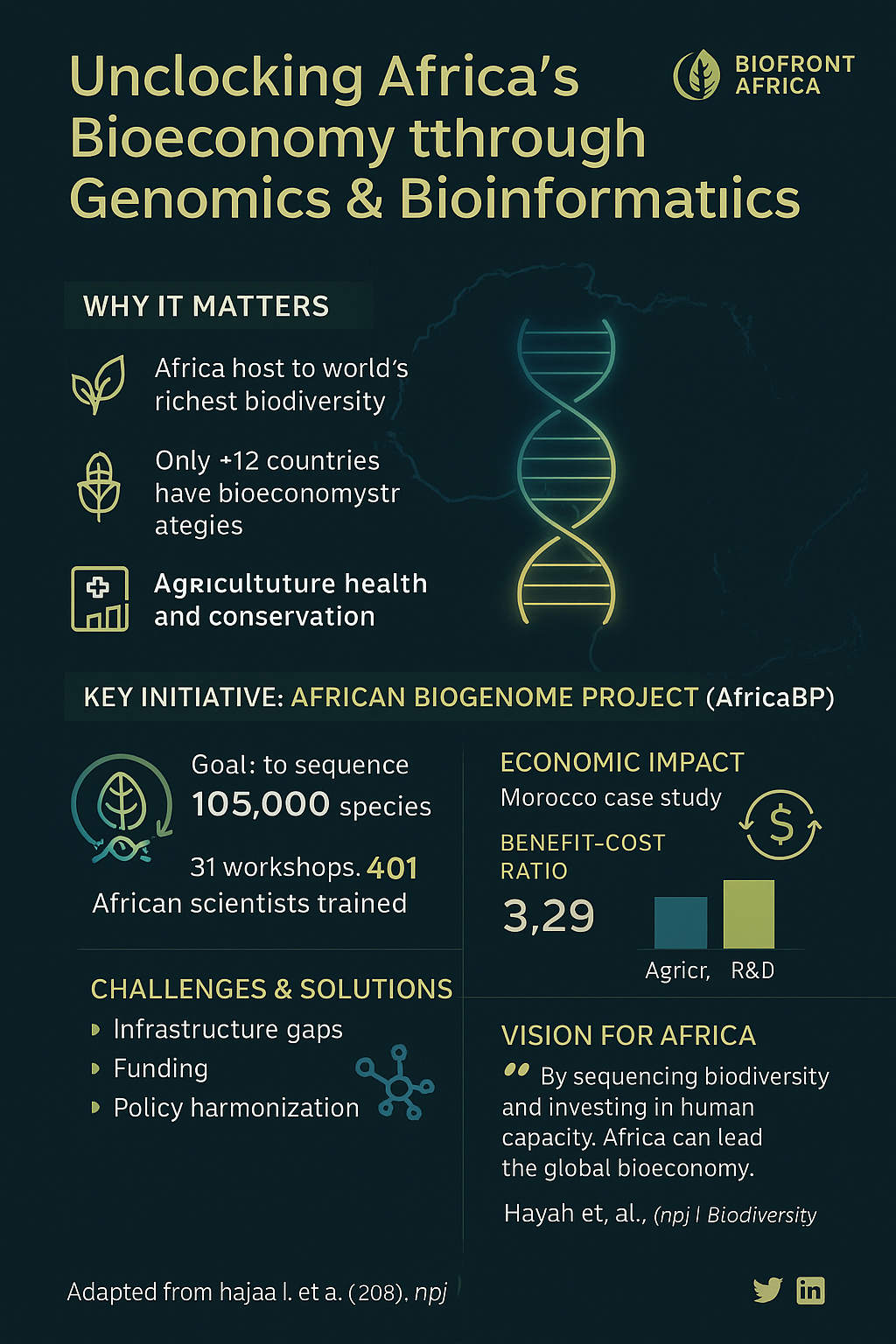
A central element of the review is the African BioGenome Project (AfricaBP), a continent-wide initiative aimed at sequencing approximately 105,000 non-human eukaryotic genomes (including plants, animals, fungi, and protozoa) to enhance food security, biodiversity conservation, and bio-industry. The review documents how the AfricaBP Open Institute has organized 31 workshops in 2024, training 401 African researchers across 50 countries in genomics, bioinformatics, molecular biology, biobanking, and ethics.
C. Economic Impact & Case Study: Moroccan Genome Project
The review includes a case study of the proposed 1000 Moroccan Genome Project to illustrate the economic benefits: a cost–benefit analysis found a Benefit–Cost Ratio (BCR) of approximately 3.29, indicating that every US$1 invested yields about US$3.29 in benefits over ten years. The largest sectoral benefits are projected in agriculture (~53% of output) and research and development (~40%).
D. Applications: Agriculture, Livestock, and Conservation
- Agriculture & Livestock Genomics: Genome assemblies for African cattle breeds, identification of drought-resistant crop loci, and enhanced breeding programs.
- Biodiversity & Conservation: Genomic tools, such as DNA barcoding and high-quality reference genomes, applied to endemic and endangered species, enabling improved species management and ecosystem resilience.
- Cross-Cutting Issues: Ethics, data policy, benefit-sharing, intellectual property, and the commercialization of genomic data.
Recommendations & Strategic Priorities
Hayah et al. outline a roadmap for integrating genomics and bioinformatics into Africa’s bioeconomy strategies:
- Establish regional sequencing hubs and in-continent infrastructure to reduce dependency on foreign laboratories.
- Expand training programs and build human capital in genomics, bioinformatics, molecular biology, and data science.
- Prioritize high-impact species, such as drought-tolerant crops and disease-resistant livestock, for sequencing and innovation.
- Develop robust data governance frameworks, including Digital Sequence Information (DSI), to ensure equitable benefit-sharing and protect indigenous knowledge.
- Strengthen public-private partnerships, provide fiscal incentives, and link research outcomes to marketable products and services.
Implications for Africa’s BioFrontiers
For the BioFront Africa hub and its audience, this review presents several important takeaways:
- Research & Innovation: There is a clear need for Africa-led genomics programs that address agriculture, health, and conservation simultaneously.
- Capacity Building: Investing in training, infrastructure, and digital bioinformatics will generate local expertise and reduce the brain drain.
- Economic Growth: Bio-based industries, such as crop improvement, biopharmaceuticals, and conservation genomics, can provide measurable returns on investment and drive job creation and value addition.
- Sustainability & Equity: It is critical to ensure that genomic advancements serve biodiversity conservation, climate resilience, and local communities for long-term impact.
Challenges & Gaps
Despite the optimism, the review identifies several setbacks:
- Africa’s average R&D investment is approximately 0.45% of GDP, which is significantly below the global average of about 1.7%.
- Few African countries have fully developed bioeconomy strategies, with only around 12 identified in the review.
- Infrastructure, policy harmonization, equitable data sharing, and funding continue to be key bottlenecks.
Conclusion
In summary, Hayah et al. (2025) present a compelling argument that genomics and bioinformatics are not only scientific frontiers but also strategic levers for Africa’s sustainable future. By sequencing biodiversity, building human and digital infrastructure, and integrating these into national bioeconomy frameworks, African nations can accelerate sustainable industries, conserve their natural heritage, and create value for local communities. As the world shifts toward bio-based solutions, Africa has both the resources and the opportunity to take the lead.
This article was adapted from an original manuscript by Hayah I., Ezebuiro V., Kagame S.P., et al. (2025) “Unlocking the African bioeconomy and strengthening biodiversity conservation through genomics and bioinformatics.” npj Biodiversity, 4, 29. Nature